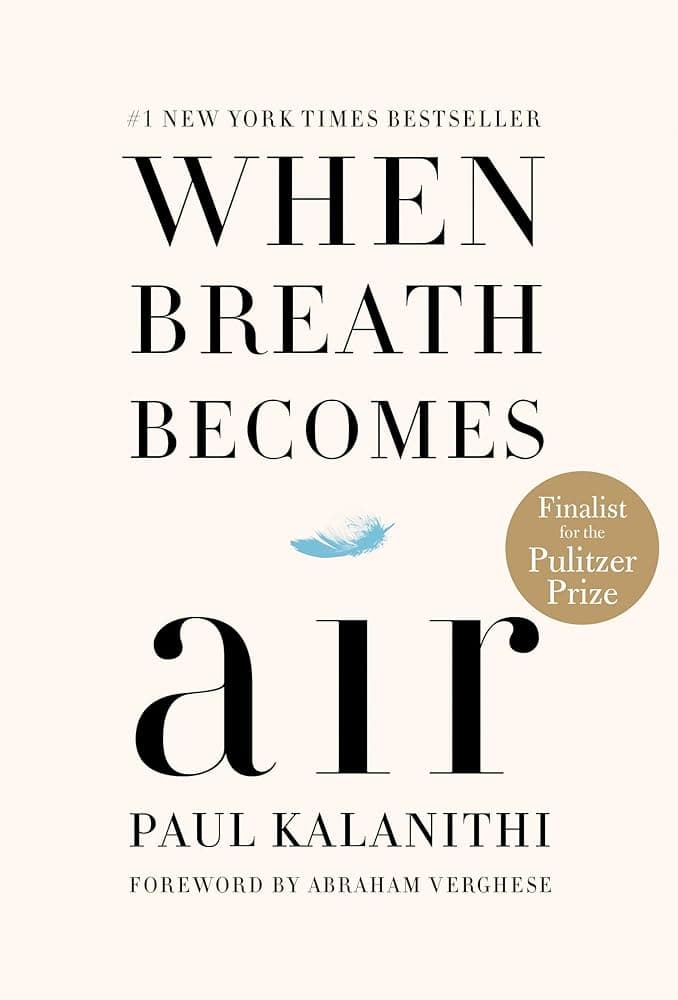
This book has been a slow burn for me; I still think about it often.
It’s a memoir written by a neurosurgeon just about to finish his residency at age 36, whose plans are interrupted by lung cancer. In the memoir, Paul wrestles with a host of questions, but the one I found most interesting is: How can you make the most of your time on Earth when that amount of time is unknown?
The way forward would seem obvious, if only I knew how many months or years I had left. Tell me three months, I’d spend time with family. Tell me one year, I’d write a book. Give me ten years, I’d get back to treating diseases. The truth that you live one day at a time didn’t help: What was I supposed to do with that day?
It’s a question we should all wrestle with. No matter how healthy or young you are, you might die tomorrow, and you might live a long life. Paul offers no explicit answer to this question but we can glean much from his actions:
1. I can’t go on. I’ll go on.
After his first course of treatment yielded promising results, Paul decides to return to his residency knowing there’s a good chance he won’t finish it. He does so because “even if I’m dying, until I actually die, I am still living.” No diagnosis will change the fact that he wants to become a neurosurgeon. Though returning to the operating room becomes much harder for Paul, he pushes through with the seven words: “I can’t go on. I’ll go on.”
2. Wouldn’t it be great if it did?
Perhaps the most consequential decision Paul makes after his first course of treatment is to have a kid with his wife Lucy. Lucy was fully in favour of the decision and prepared to raise a child on her own if necessary. The only question she had for Paul was: “Don’t you think saying goodbye to your child will make your death more painful?” To which Paul replies, “Wouldn’t it be great if it did?” After all, what could be better evidence of a life well lived than having something that makes saying goodbye so hard?
Paul’s story hits close to home for me because while I am no neurosurgeon, I also spend much of my days setting up “future me” for success, despite the fact that tragedy can strike at any time and put all my hard work to "waste". When death comes knocking, whenever that may be, I, too, hope I will have lived my life in a manner which makes it hard to say goodbye. It’s a goal I will carry with me into 2026 and beyond.
P.S. He gets bonus points for being a very very good writer. My favourite passage happens to be the last paragraph of the book (which remains unfinished due to his passing). In it, he leaves a message for his daughter Cady:
When you come to one of the many moments in life where you must give an account of yourself, provide a ledger of what you have been, and done, and meant to the world, do not, I pray, discount that you filled a dying man’s days with a sated joy, a joy unknown to me in all my prior years, a joy that does not hunger for more and more but rests, satisfied.